
The digital economy across India and the Middle East is experiencing an unprecedented boom. From fast-growing direct-to-consumer (D2C) e-commerce brands in Mumbai and Bengaluru to tech-driven financial ventures across Dubai, Riyadh, and Cairo, businesses are scaling at lightning speed. However, this hyper-growth has also attracted a less welcome trend: sophisticated, business-crippling cyber threats.
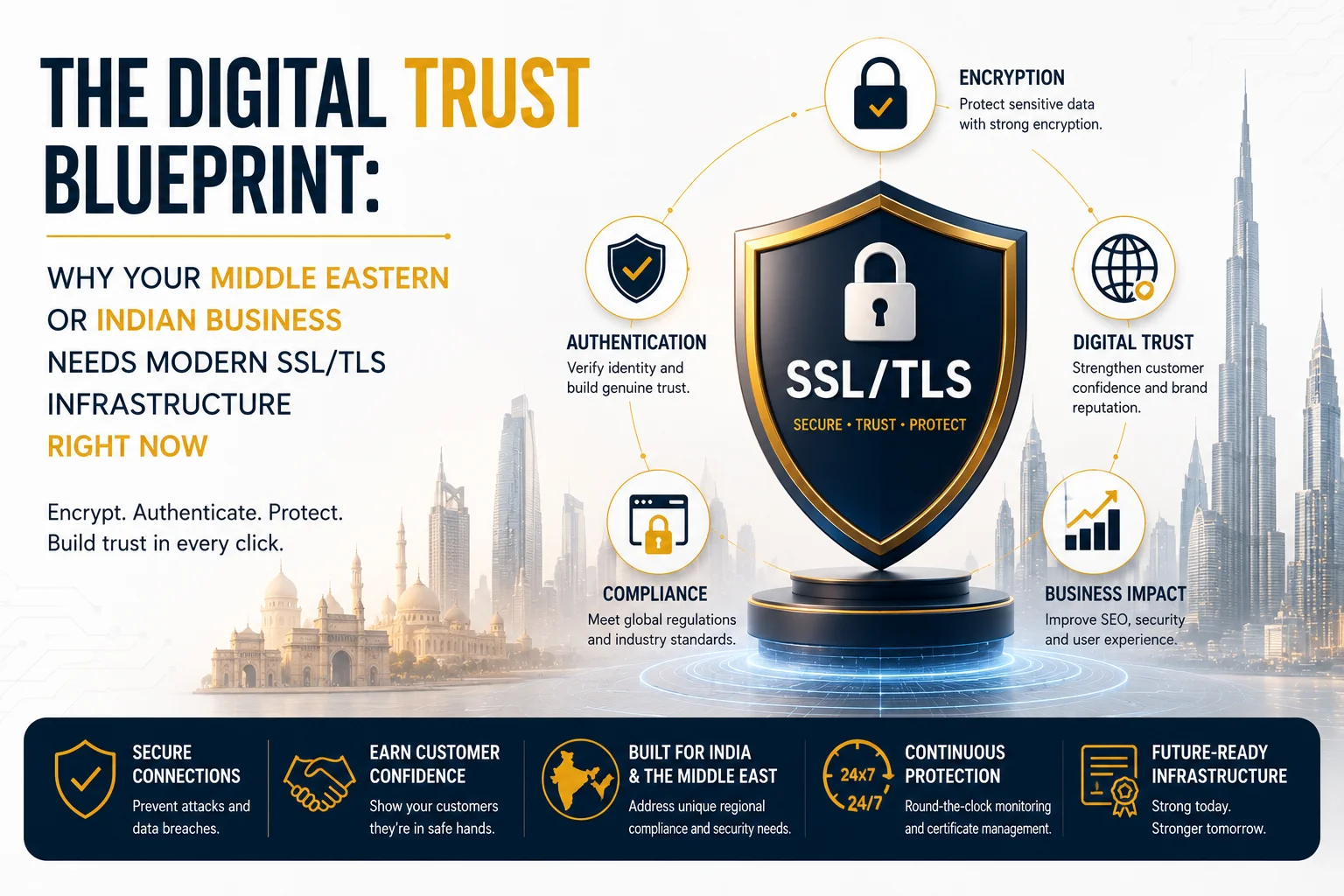
For any organization operating online, customer trust is your most valuable currency. If a consumer in Delhi or Jeddah visits your website or enterprise portal and sees a “Not Secure” warning in their browser bar, they will leave immediately, fracturing your brand reputation. The foundational shield against this loss of trust is SSL (Secure Sockets Layer)—or more accurately in 2026, its modern cryptographic evolution, TLS (Transport Layer Security).
Let’s break down exactly what SSL/TLS is, how it protects your business, the shifting regulatory and compliance landscapes in your region, and how to eliminate the operational risks of manual certificate management.
What is SSL/TLS and How Does It Work?
At its core, an SSL/TLS certificate is a digital passport for your website or web application. It serves two vital cryptographic purposes:
- Data Encryption: It scrambles the information traveling between your user’s web browser and your corporate server. If a customer enters their credit card details, government ID numbers, or login credentials, encryption turns that data into unreadable code. Even if a hacker intercepts the data stream, they only see absolute gibberish.
- Identity Authentication: It proves that your server is legitimate. It verifies that you are who you say you are, preventing bad actors from building a fake replica of your site to launch phishing attacks or steal user data.
The Technical Reality: SSL vs. TLS
When people say “SSL certificate,” they are actually using an outdated term out of habit. The original Secure Sockets Layer protocol was developed in the 1990s and has long been deprecated due to security flaws. Today, we use TLS 1.2 and TLS 1.3 to secure digital channels.
TLS 1.3 is the current universal standard, offering a much faster cryptographic “handshake” (the initialization of a secure connection) and significantly stronger protection against modern exploits. However, the industry still markets them as “SSL certificates” because that is the name the business world recognizes.
The Geo-Specific Context: Why Encryption Is Mandatory in India and the GCC
Operating a digital storefront, SaaS platform, or business portal in India and the Middle East comes with unique market dynamics that turn data protection from a “best practice” into a legal and commercial mandate.
1. Tightening Local Compliance & Data Regulations
Governments across both regions are actively cracking down on data privacy and identity security.
- In India: The Digital Personal Data Protection (DPDP) Act mandates that any business handling consumer data must deploy robust security measures to prevent unauthorized data exposure. Furthermore, bodies like the Reserve Bank of India (RBI), SEBI, and IRDA impose strict security directives for encryption and infrastructure uptime.
- In the GCC: Frameworks like Saudi Arabia’s Personal Data Protection Law (PDPL) and the UAE’s federal data regulations place severe compliance burdens on organizations. Failing to encrypt user data or suffering a breach due to an expired certificate can result in massive financial penalties, legal investigations, and devastating blowback from stakeholders.
2. The Explosive Rise of UPI and Digital Wallets
India’s Unified Payments Interface (UPI) and the Middle East’s rapidly evolving fintech ecosystem (like mada, STC Pay, and Apple Pay) mean consumers are interacting with financial interfaces daily. Local consumers have become highly tech-savvy. They look for visual indicators of security—like the lock icon next to the URL or the https:// prefix—before completing a transaction.
3. Search Engine Visibility (SEO)
If your website relies on organic traffic to bring in customers from regions like Mumbai, Dubai, or Muscat, you cannot afford to skip encryption. Google uses HTTPS as a core ranking signal. Unencrypted websites (http://) are actively penalized in search visibility. Worse yet, modern web browsers display a prominent warning to visitors trying to access an unencrypted site, driving your bounce rates through the roof.
Understanding the Types of SSL/TLS Certificates
Depending on the scale of your business and the sensitivity of the data you handle, you will choose from three primary validation levels:
| Certificate Type | Verification Level | Best For |
| Domain Validation (DV) | Low. The Certificate Authority (CA) only checks that you have control over the domain name. | Content blogs, static landing pages, and small informational sites. |
| Organization Validation (OV) | Medium. The CA verifies domain ownership alongside your legally registered business identity. | Corporate websites, B2B portals, and standard e-commerce setups. |
| Extended Validation (EV) | High. Rigorous legal, physical, and operational background checks are performed on your organization. | Banking apps, payment gateways, large-scale enterprise brands, and regulated sectors. |
Beyond these, businesses also use Wildcard Certificates (to secure a main domain and unlimited subdomains like *.yourcompany.com) and Multi-Domain/SAN Certificates (to secure completely different domains under a single certificate) to clean up their digital estate.
The Silent Operational Hazard: Shorter Lifespans
The rules of digital security are shifting rapidly. Previously, you could purchase an SSL certificate that lasted for two or three years before needing manual renewal.
Critical Security Shift: To minimize the risk of compromised or stolen certificates being misused by bad actors, the global CA/Browser Forum has drastically shortened maximum certificate lifespans. Certificates are moving toward a mandatory maximum validity window of roughly six months, with long-term industry plans to shrink them even further to 90 days or fewer.
For an enterprise IT team or CISO, managing dozens—or thousands—of domains, APIs, and subdomains manually every few months is an operational nightmare. If a single certificate expires unnoticed, your entire website or application goes down, throwing up scary security alerts that terrify your customers and stop your revenue engines instantly. This makes automated lifecycle management an absolute requirement for modern business infrastructure.
Step-by-Step: The Lifecycle of a Certificate
Setting up an SSL/TLS architecture requires absolute precision. Missing a step can lead to broken pages or mixed-content errors. Follow this critical sequence to ensure your platform is safely encrypted:
- Assess Requirements & Choose Certificate Type:Step 1.
Identify your domain structure (single, wildcard, or multi-domain) and match it against your required trust level (DV, OV, or EV) based on local regulatory standards.
2. Generate a CSR (Certificate Signing Request):Step 2.
Log into your web server or hosting environment and generate a CSR file. This contains your public key and verified corporate details which are transmitted securely to the Certificate Authority.
3.Complete Identity Validation:Step 3.
The Certificate Authority will verify your identity. For DV, this takes minutes via DNS records. For OV and EV, you must provide official business registry documents matching your country’s corporate laws.
4.Install the Certificate on Your Web Server:Step 4.
Once issued, download the certificate files and upload them to your web server infrastructure (such as Apache, Nginx, or IIS). Ensure the complete intermediate certificate chain is installed to avoid browser trust issues.
5.Enforce Strict HTTPS Redirection & HSTS:Step 5.
Configure server-level rules to automatically force all inbound traffic from http:// to https://. Implement HSTS (HTTP Strict Transport Security) to instruct user browsers to exclusively interact with your secure layout.
The Solution: AmbiSure Certificate Lifecycle Management (CLM)
Manual tracking with spreadsheets is a recipe for catastrophic downtime. To thrive in the hyper-fast Indian and Middle Eastern digital landscapes, enterprises need automated governance.
AmbiSure’s Certificate Lifecycle Management (CLM) platform streamlines the entire process, eliminating human error, boosting operational efficiency, and safeguarding your organization’s digital trust.
Why Enterprises Trust AmbiSure:
- End-to-End Automation: From automated discovery of hidden certificates across your network to seamless issuance and hands-off renewal, AmbiSure takes the operational burden completely off your IT team.
- Regulatory Compliance Automation: Pre-mapped directly to regional frameworks like the RBI, SEBI, IRDA, and PCI DSS, AmbiSure ensures you are always audit-ready with complete cryptographic logs.
- Real-Time Monitoring & Visibility: Gain a single-pane-of-glass dashboard that continuously tracks certificate health, expiration dates, and configuration vulnerabilities across multi-cloud and hybrid environments.
- Post-Quantum Readiness: Built with crypto-agility, AmbiSure prepares your enterprise for future post-quantum cryptographic standards, keeping your data secure for the long haul.
Secure Your Business Future Today
In highly competitive hubs like Dubai, Mumbai, Riyadh, and Delhi, digital acceleration is moving at a breakneck pace. Leaving your platform unencrypted, using outdated ciphers, or relying on manual renewal methods introduces immense operational risk. Securing your digital footprint shouldn’t be a painful IT task—it should be a strategic advantage.
Partner with AmbiSure to completely automate your SSL/TLS certificate infrastructure, maximize your platform uptime, and keep your customer data locked down tight.
Protect Your Customers and Scale Safely
Don’t wait for a costly certificate expiration or an audit failure to disrupt your business.
