
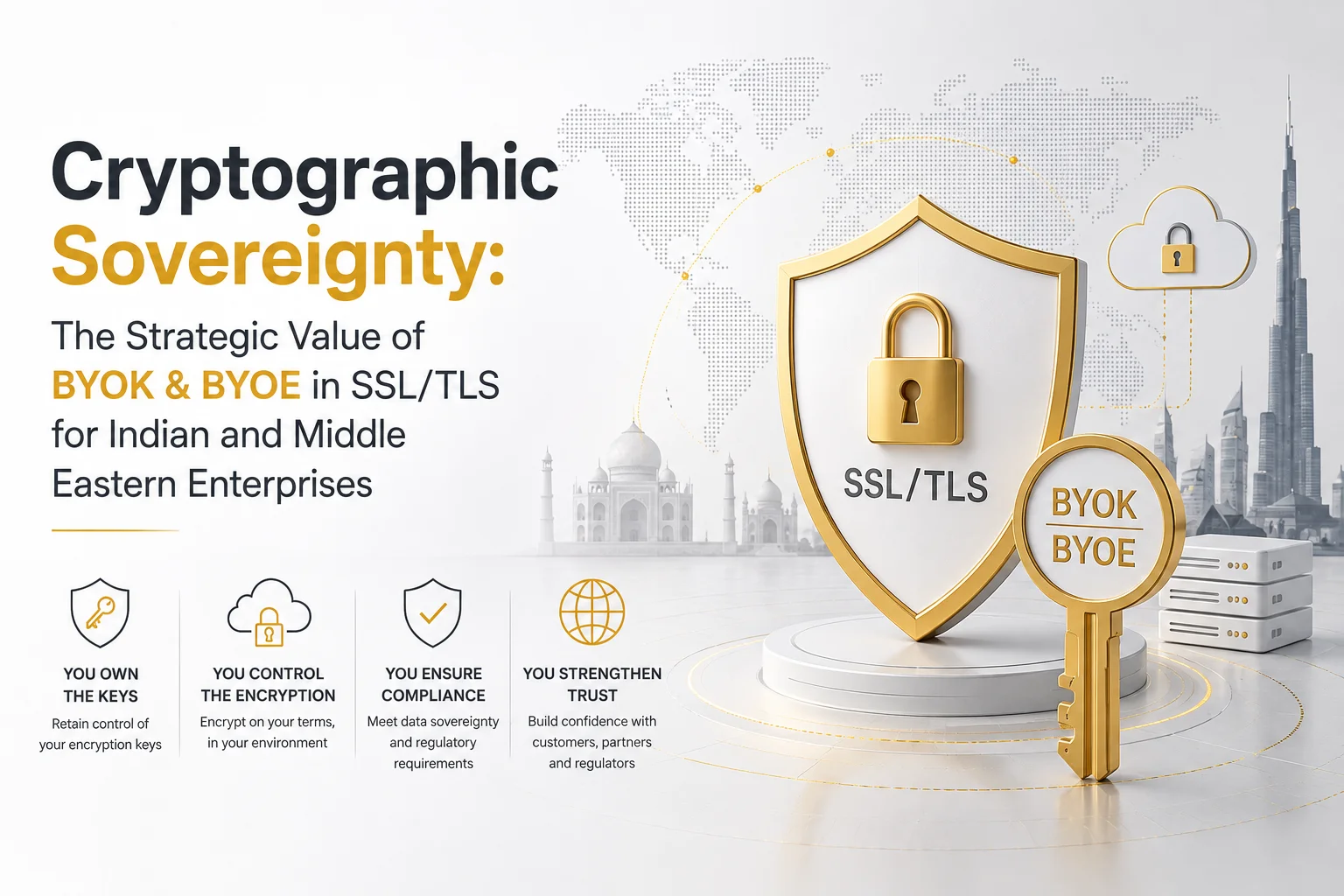
The multi-cloud rush across India and the Middle East has completely rewritten the enterprise security playbook. As conglomerates in Mumbai, tech scale-ups in Bengaluru, and financial powerhouses across Dubai, Riyadh, and Doha migrate their mission-critical workloads to public clouds, they face an fundamental paradox: How do you embrace the operational agility of global cloud service providers (CSPs) while maintaining absolute, uncompromising control over your data?
For heavily regulated sectors, simply handing over data protection keys to a third-party host is no longer a viable option. If your cloud-hosted platforms or external application programming interfaces (APIs) rely on standard, provider-managed encryption, your most sensitive corporate assets remain exposed to host-level vulnerabilities and data-sovereignty gaps.
To bridge this trust gap, forward-thinking Chief Information Security Officers (CISOs) are moving past generic cloud setups. They are demanding Bring Your Own Key (BYOK) and Bring Your Own Encryption (BYOE) models. When applied to Secure Sockets Layer / Transport Layer Security (SSL/TLS) and broader data layers, these advanced paradigms shift cryptographic control directly back to where it belongs: your enterprise.
Defining the Stack: Understanding BYOK vs. BYOE
While both methodologies are designed to prevent unauthorized third-party visibility into your workloads, they operate at entirely different depths of the cryptographic stack.
DATA LAYER 0
BRING YOUR OWN KEY (BYOK) BRING YOUR OWN ENCRYPTION (BYOE)
✔ Enterprise Generates Keys ✔ Enterprise Generates Keys
✘ CSP Executes Encryption ✔ Enterprise Runs Software
✘ CSP Manages Cryptography ✔ Full Stack Sovereignty
Bring Your Own Key (BYOK)
In a standard BYOK arrangement, your organization generates its own master cryptographic key material locally—typically utilizing a dedicated, on-premises Hardware Security Module (HSM). This key material is securely transmitted via API into the cloud provider’s Key Management Service (KMS).
While you control the lifecycle of the key (including generation, rotation, and revocation), the cloud provider’s native cryptographic engines still perform the actual encryption and decryption operations on your behalf.
Bring Your Own Encryption (BYOE)
BYOE takes data sovereignty to its logical absolute. Rather than relying on the cloud provider’s underlying cryptographic framework, your enterprise deploys its own virtualized encryption software directly alongside your cloud applications.
Your data is fully encrypted at the application or database layer before it ever interacts with the cloud provider’s physical storage arrays. The cloud provider acts as a blind utility host; they store the encrypted ciphertext but possess absolutely no visibility into your keys, your cipher suites, or your raw data streams.
Why Cryptographic Sovereignty Is Mandatory in India and the GCC
Operating a digital enterprise across the Indian subcontinent and the Gulf Cooperation Council (GCC) places businesses at the intersection of strict compliance and escalating targeted cyber threats.
1. Hardened Compliance Architecture
Data residency is no longer a luxury. Under India’s Digital Personal Data Protection (DPDP) Act, companies are legally accountable for establishing rigorous safeguards against data exposure. Sectoral regulators like the Reserve Bank of India (RBI), SEBI, and IRDAI heavily penalize organizations that cede structural data control to external hosts.
Simultaneously, Saudi Arabia’s Personal Data Protection Law (PDPL) and the UAE’s federal data protection frameworks mandate strict, locally audited parameters on how data is handled. BYOK and BYOE models provide clear, unassailable audit trails proving that your company maintains exclusive, sovereign ownership over its data keys.
2. Eliminating Vendor Lock-In and Multicloud Risk
Most modern enterprises do not rely on a single cloud vendor. Operating a hybrid architecture across AWS, Microsoft Azure, and Google Cloud platform creates fragmented security boundaries. Relying on each provider’s distinct, native encryption tools leads to inconsistent security postures.
Implementing an independent BYOK/BYOE layer centralizes your cryptographic management. It ensures that whether an application is running in an on-premises data center in Mumbai or a cloud cluster in Riyadh, it utilizes the exact same high-strength cryptographic standards.
3. Protection Against Cloud-Level Compromise
While global cloud providers maintain world-class physical security, they are not immune to logic flaws, hypervisor vulnerabilities, or insider threats. If a bad actor or government agency demands access to a cloud provider’s infrastructure, provider-managed keys can theoretically be used to decrypt your assets without your explicit knowledge. BYOE mathematically eliminates this risk. If the host doesn’t have the key, they cannot reveal the data.
Deploying Sovereign Encryption: The Operational Lifecycle
Migrating away from provider-managed encryption toward a robust BYOK or BYOE posture requires a highly structured execution strategy to prevent accidental configuration lockouts or platform downtime.
1.Establish Root Cryptographic Trust:Phase 1.
Deploy a dedicated, FIPS 140-2 Level 3 or Level 4 compliant Hardware Security Module (HSM) on-premises or within a secure, isolated private cloud to generate your high-entropy master keys.
2.Configure Cloud Access Policies:Phase 2.
Define rigorous Identity and Access Management (IAM) and Role-Based Access Control (RBAC) boundaries within your Key Management Service (KMS), limiting who can call or use the cryptographic keys.
3.Secure Key Transport and Import:Phase 3.
Wrap your locally generated master key using the cloud provider’s public wrapping key. Securely import the wrapped key into the targeted cloud KMS via a hardened API connection.
4.Deploy Application-Layer Encryption:Phase 4.
For BYOE setups, integrate localized cryptographic libraries directly into your application code or container workloads. Encrypt sensitive data payloads at rest and in transit before transmission to cloud databases.
5.Enforce Continuous Auditing & Rotation:Phase 5.
Link your cryptographic infrastructure to real-time security monitoring tools. Establish automated, non-disruptive key rotation cycles to render older key iterations obsolete and minimize attack surfaces.
Structural Evaluation: Navigating the Trade-offs
Moving to advanced key management models brings undeniable security advantages, but it also alters your day-to-day operational mechanics.
| Evaluation Parameter | Provider-Managed Encryption | Bring Your Own Key (BYOK) | Bring Your Own Encryption (BYOE) |
| Data Control Level | Minimal. CSP holds full structural access. | Shared. You own key material; CSP runs encryption. | Absolute. CSP has zero visibility into data or keys. |
| Regulatory Standing | Weak. Often fails strict localized audits. | Strong. Fully satisfies DPDP, PDPL, and RBI requirements. | Maximum. Total cryptographic sovereignty across borders. |
| Operational Overhead | Zero. Managed entirely by the cloud provider. | Balanced. Requires lifecycle key tracking. | Higher. Requires application-level management. |
| Mitigation of Cloud Breaches | Vulnerable to host-level exploitation. | Partially protected against external actors. | Fully Shielded. Immune to underlying host compromise. |
Eliminate Cryptographic Complexity with AmbiSure
The primary barrier to adopting BYOK and BYOE architectures is the immense operational overhead. Manually managing hardware security modules, overseeing multi-cloud key synchronization, keeping up with rapid rotation schedules, and avoiding application downtime is an incredibly challenging task for already overextended enterprise IT departments.
AmbiSure’s Advanced Certificate Lifecycle Management (CLM) and Public Key Infrastructure (PKI) solutions completely eliminate the friction of modern corporate cryptography. AmbiSure provides a unified, enterprise-grade platform built specifically to help organizations deploy, manage, and scale sovereign encryption structures across hybrid and multi-cloud environments seamlessly.
The AmbiSure Advantage:
- Unified Cryptographic Orchestration: Consolidate your BYOK, BYOE, and traditional SSL/TLS certificate management under a single, central dashboard. Eliminate visibility blind spots and prevent human-error configuration slip-ups.
- Localized Regulatory Alignment: Pre-configured and dynamically mapped to meet the strict cybersecurity frameworks of RBI, SEBI, IRDAI, India’s DPDP Act, and GCC data privacy regulations. Generate instantly downloadable, audit-ready compliance reports.
- Hardware-Backed Security: Seamlessly bridge your local, high-security FIPS-compliant HSMs with leading public cloud environments to ensure your master key material never leaks or drops its protective posture.
- Crypto-Agility & Post-Quantum Defense: Protect your critical business records against future threats. AmbiSure builds active crypto-agility directly into your infrastructure, enabling quick, effortless migrations to post-quantum cryptographic standards without breaking system dependencies.
Secure Your Enterprise Assets Today
In the high-velocity digital landscapes of Mumbai, New Delhi, Dubai, and Riyadh, digital transformation cannot happen at the expense of data security. Relying on basic, host-level encryption keys leaves your business exposed to compliance issues, platform lock-in, and catastrophic cloud data breaches. Taking back control of your cryptographic foundation is the definitive way to secure customer trust and shield your corporate data.
Partner with AmbiSure to automate your cryptographic orchestration, deploy bulletproof BYOK/BYOE frameworks, and protect your digital infrastructure.
Take Control of Your Encryption Architecture
Don’t let third-party cloud vulnerabilities dictate your security posture or risk your compliance standing.