
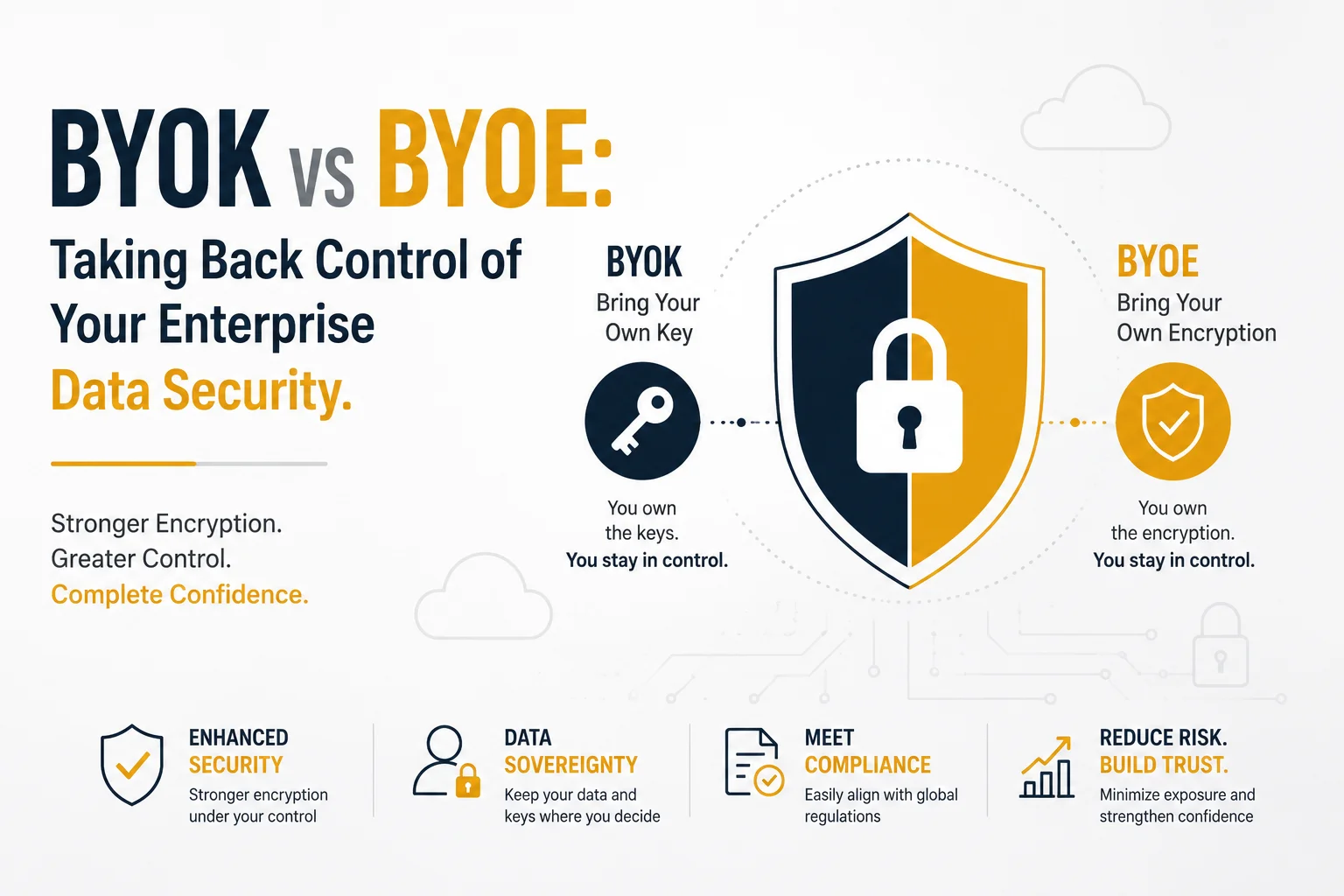
BYOK and BYOE are becoming essential cloud security strategies for enterprises across India and the Middle East. As organizations move critical workloads to AWS, Microsoft Azure, Google Cloud, and hybrid cloud environments, controlling encryption keys and protecting sensitive business data has become a top cybersecurity priority. BYOK (Bring Your Own Key) and BYOE (Bring Your Own Encryption) help organizations strengthen data security, meet compliance requirements, and improve cyber resilience against modern threats.
Cloud adoption is accelerating across India and the Middle East as organizations modernize their digital infrastructure, embrace AI-powered applications, migrate critical workloads to public cloud platforms, and expand hybrid work environments. Industries including banking, healthcare, government, manufacturing, oil & gas, retail, telecommunications, and logistics are handling larger volumes of sensitive information than ever before. While cloud platforms provide flexibility, scalability, and operational efficiency, they also introduce one critical question that every CISO, CIO, CTO, and compliance leader must answer:
Who really controls your encryption keys?
Many organizations assume that encrypting their data in the cloud automatically ensures security. However, encryption is only as strong as the control over the encryption keys. If cloud providers generate and manage the encryption keys, organizations may lose direct control over their most valuable digital assets.
This is where Bring Your Own Key (BYOK) and Bring Your Own Encryption (BYOE) have become essential cybersecurity strategies. They provide enterprises with greater ownership, stronger security, improved compliance, and better protection against modern cyber threats.
As cyber regulations become stricter across India, Saudi Arabia, UAE, Qatar, Oman, Kuwait, and Bahrain, organizations are increasingly adopting customer-controlled encryption to meet data sovereignty requirements while strengthening cyber resilience.
Understanding BYOK (Bring Your Own Key)
Bring Your Own Key (BYOK) enables organizations to generate encryption keys within their own secure environment instead of allowing the cloud provider to create them. These encryption keys are securely imported into cloud platforms such as Microsoft Azure, AWS, or Google Cloud while ownership remains with the customer.
Unlike provider-managed keys, BYOK allows security teams to determine how keys are generated, rotated, revoked, archived, and monitored.
With BYOK, enterprises gain complete visibility into key lifecycle management while significantly reducing dependency on third-party cloud providers.
The primary objective of BYOK is simple: Your data remains under your control because your encryption keys remain under your control.
What is BYOE (Bring Your Own Encryption)?
Bring Your Own Encryption (BYOE) takes security a step further.
Instead of relying on cloud-native encryption mechanisms, organizations encrypt sensitive information before it reaches the cloud. The cloud provider only stores encrypted data and never has access to plaintext information or encryption secrets.
This approach significantly reduces insider risks, limits exposure during cloud breaches, and provides an additional security layer against sophisticated cyberattacks.
BYOE is particularly valuable for organizations managing:
- Financial transactions
- Healthcare records
- Intellectual property
- Government information
- Defense projects
- Manufacturing designs
- Customer databases
- AI training datasets
Even if attackers compromise cloud infrastructure, encrypted data remains unreadable without the customer-controlled encryption keys.
BYOK vs BYOE: Understanding the Difference
Although both approaches focus on encryption ownership, they solve different security challenges.
| BYOK | BYOE |
| Customer owns encryption keys | Customer owns entire encryption process |
| Cloud provider performs encryption | Organization encrypts data before cloud upload |
| Easier cloud integration | Highest level of security |
| Strong compliance capabilities | Maximum data privacy |
| Lower implementation complexity | Advanced enterprise security architecture |
Many highly regulated organizations implement both BYOK and BYOE together to achieve layered defense.
Why Enterprises in India and the Middle East Are Moving Toward BYOK and BYOE
Digital transformation initiatives across the GCC and India have increased cloud adoption dramatically. Governments are introducing stricter cybersecurity frameworks that emphasize customer-controlled encryption and stronger data governance.
Organizations operating in these regions face increasing pressure to protect:
- Customer financial information
- Personally identifiable information (PII)
- Healthcare records
- Government documents
- Critical infrastructure
- Oil & Gas operational data
- Manufacturing intellectual property
- Cross-border business information
Using provider-managed encryption alone may no longer satisfy regulatory expectations.
BYOK and BYOE provide enterprises with greater confidence that sensitive data remains protected regardless of where it is stored.
Key Business Benefits of BYOK
1. Complete Ownership of Encryption Keys
Organizations decide how encryption keys are generated, stored, rotated, and retired without relying entirely on cloud vendors.
2. Improved Regulatory Compliance
Customer-controlled encryption supports compliance initiatives related to:
- ISO 27001
- PCI DSS
- RBI Cyber Security Framework
- DPDP Act (India)
- UAE Information Assurance Standards
- Saudi NCA ECC
- GDPR
- HIPAA
- SOC 2
This helps simplify regulatory audits while demonstrating stronger governance.
3. Reduced Insider Risk
Cloud administrators cannot easily access encrypted enterprise data when customer-controlled encryption keys are used.
4. Vendor Independence
Organizations maintain greater flexibility when migrating between cloud providers because encryption ownership remains internal.
5. Stronger Ransomware Resilience
Even if cloud storage is compromised, encrypted information remains significantly harder for attackers to exploit.
Why BYOE Offers an Even Higher Level of Security
BYOE is becoming increasingly popular among enterprises adopting Zero Trust architectures.
Major benefits include:
- End-to-end encryption
- Protection before cloud upload
- Reduced cloud provider visibility
- Enhanced privacy
- Stronger protection against insider threats
- Better support for confidential workloads
- Greater resilience against cloud infrastructure compromise
For sectors handling highly confidential information, BYOE provides an additional layer of protection beyond traditional cloud security.
Industries That Benefit Most from BYOK and BYOE
Banking & Financial Services
Financial institutions manage payment systems, transaction records, digital banking platforms, and customer identities. Customer-controlled encryption helps minimize fraud risks while supporting regulatory compliance.
Healthcare
Hospitals, laboratories, and healthcare providers protect patient records, diagnostic reports, and confidential medical information.
Government & Public Sector
Government agencies increasingly require sovereign control over sensitive citizen data and national infrastructure.
Manufacturing
Industrial organizations protect proprietary designs, production systems, supplier information, and operational technology environments.
Oil & Gas
Energy companies secure exploration data, operational technology, engineering designs, and mission-critical infrastructure.
Retail & E-commerce
Customer payment details, purchase histories, and loyalty information require stronger encryption to prevent data breaches.
BYOK and BYOE Within a Zero Trust Security Strategy
Modern cybersecurity assumes that no user, device, application, or network should be trusted by default.
BYOK and BYOE naturally complement Zero Trust by ensuring:
- Data remains encrypted everywhere.
- Encryption keys stay under customer control.
- Access follows least-privilege principles.
- Compromised cloud environments cannot easily expose plaintext data.
- Security teams maintain continuous visibility over encryption operations.
Together, they strengthen identity protection, privileged access management, and secure cloud architecture.
Common Challenges During Implementation
Although BYOK and BYOE offer significant advantages, successful implementation requires careful planning.
Organizations commonly face:
- Complex key lifecycle management
- Integration with existing cloud workloads
- Multi-cloud encryption consistency
- Hardware Security Module (HSM) integration
- Secure key rotation processes
- Disaster recovery planning
- Encryption performance optimization
- Compliance reporting
Without expert guidance, misconfigured encryption can create operational risks or affect application availability.
Best Practices for Successful BYOK and BYOE Deployment
Organizations should adopt a structured implementation approach:
- Generate keys using certified Hardware Security Modules (HSMs).
- Establish secure key rotation and revocation policies.
- Integrate encryption with Identity and Access Management (IAM).
- Enable continuous monitoring of key usage and anomalies.
- Protect backup encryption keys securely.
- Test disaster recovery procedures regularly.
- Align encryption policies with Zero Trust architecture.
- Conduct regular security assessments and compliance audits.
- Continuously review cloud security posture and encryption configurations.
Combining these practices helps maximize both security and operational efficiency.
How AmbiSure Technologies Helps Organizations Secure BYOK and BYOE
Implementing customer-controlled encryption requires expertise across cloud security, identity management, governance, compliance, incident response, and continuous monitoring.
AmbiSure Technologies helps enterprises across India, the UAE, Saudi Arabia, Qatar, Oman, Kuwait, Bahrain, and the wider Middle East design and implement robust BYOK and BYOE strategies tailored to their business and regulatory requirements.
Our cybersecurity experts assist organizations with:
- BYOK architecture design and deployment
- BYOE implementation for sensitive workloads
- Cloud security assessments
- Encryption key lifecycle management
- Hardware Security Module (HSM) integration
- Zero Trust security implementation
- Identity and Access Management (IAM)
- Security Operations Center (SOC) services
- Cloud security posture management
- Incident Response and ransomware readiness
- Compliance consulting for ISO 27001, NCA ECC, RBI, DPDP, PCI DSS, GDPR, and other regulatory frameworks
Whether your organization operates in a single cloud, hybrid environment, or multi-cloud ecosystem, AmbiSure delivers practical, scalable, and compliance-focused encryption solutions that strengthen cyber resilience without disrupting business operations.
Conclusion
Cloud security is no longer just about encrypting data—it is about controlling who owns the encryption process and who controls the keys. As cyber threats continue to evolve and regulatory expectations become more demanding, BYOK and BYOE have emerged as critical pillars of modern enterprise security.
For organizations across India and the Middle East, customer-controlled encryption delivers stronger protection against ransomware, insider threats, cloud compromises, and compliance risks while enabling greater operational confidence.
Enterprises that adopt BYOK and BYOE today are not only protecting sensitive information but also building a resilient, future-ready cybersecurity foundation capable of supporting digital transformation with trust, governance, and security at its core.
Call to Action
Take Control of Your Encryption Before Attackers Do
Your cloud data is only as secure as the encryption keys protecting it. Don’t leave control in someone else’s hands.
AmbiSure Technologies helps organizations across India and the Middle East implement secure BYOK (Bring Your Own Key) and BYOE (Bring Your Own Encryption) strategies aligned with Zero Trust, regulatory compliance, and modern cloud security best practices.
Schedule a complimentary Cloud Encryption & Security Assessment with AmbiSure today to:
- Evaluate your current cloud encryption posture
- Identify security and compliance gaps
- Strengthen ransomware resilience
- Implement customer-controlled encryption
- Secure multi-cloud and hybrid cloud environments
Take ownership of your encryption. Strengthen your cyber resilience. Partner with AmbiSure Technologies today.
