
As businesses across India and the Middle East accelerate their digital transformation journeys, cybersecurity has become more than just an IT function—it is now a strategic business priority. Organizations are increasingly adopting cloud platforms, remote work environments, third-party applications, IoT devices, AI-powered technologies, and hybrid infrastructures to improve efficiency and innovation. However, every new technology introduced into the enterprise environment also creates new opportunities for cybercriminals to exploit security weaknesses.
Cyberattacks are becoming more sophisticated, with attackers constantly scanning networks for unpatched systems, misconfigured servers, outdated software, and vulnerable applications. A single overlooked vulnerability can result in ransomware attacks, data breaches, operational disruption, financial losses, and regulatory penalties. This is why Vulnerability Management has become one of the most critical components of a modern cybersecurity strategy.
Unlike a one-time vulnerability assessment, Vulnerability Management is a continuous process that helps organizations identify, assess, prioritize, remediate, and monitor security vulnerabilities before they can be exploited. At AmbiSure Technologies, we help enterprises strengthen their cyber resilience with AI-driven Vulnerability Management solutions designed to provide complete visibility into their security posture while enabling faster and more effective risk mitigation.
What Is Vulnerability Management?
Vulnerability Management is the ongoing process of discovering, evaluating, prioritizing, and resolving security weaknesses across an organization’s IT infrastructure. These vulnerabilities may exist in servers, workstations, cloud environments, applications, databases, APIs, network devices, mobile devices, or third-party software.
The objective is not only to identify vulnerabilities but also to understand which ones pose the greatest business risk. Modern organizations manage thousands of assets across multiple environments, making it impossible to manually monitor every security issue. Continuous Vulnerability Management automates this process, helping security teams focus on the vulnerabilities that matter most.
By combining continuous scanning, threat intelligence, risk prioritization, and remediation tracking, organizations can significantly reduce their attack surface and improve their overall cybersecurity posture.
Why Vulnerability Management Is Essential for Modern Enterprises
Cybercriminals are constantly searching for vulnerabilities that organizations have failed to patch. Many successful cyberattacks occur because known vulnerabilities remain unaddressed for weeks or even months. As businesses expand their digital ecosystems, traditional annual or quarterly security assessments are no longer sufficient.
Continuous Vulnerability Management enables organizations to identify newly discovered vulnerabilities in real time, prioritize remediation based on exploitability and business impact, and ensure that security gaps are addressed before attackers can exploit them. This proactive approach minimizes operational risks while supporting compliance with industry regulations and cybersecurity frameworks.
For enterprises operating in highly regulated industries such as banking, healthcare, manufacturing, energy, retail, and government, Vulnerability Management also plays an important role in maintaining customer trust and regulatory compliance.
Common Vulnerabilities That Put Businesses at Risk
Modern enterprise environments often contain thousands of vulnerabilities spread across different systems and technologies. Some of the most common include outdated operating systems, missing security patches, weak passwords, exposed APIs, insecure cloud configurations, unsupported software, default credentials, firewall misconfigurations, vulnerable web applications, and insecure remote access services.
These vulnerabilities may seem minor individually, but together they create multiple entry points for attackers. Without continuous monitoring, organizations often remain unaware of these risks until after a security incident occurs.
A comprehensive Vulnerability Management program helps organizations continuously discover these weaknesses, assess their severity, and implement timely remediation to reduce overall cyber risk.
The Vulnerability Management Lifecycle
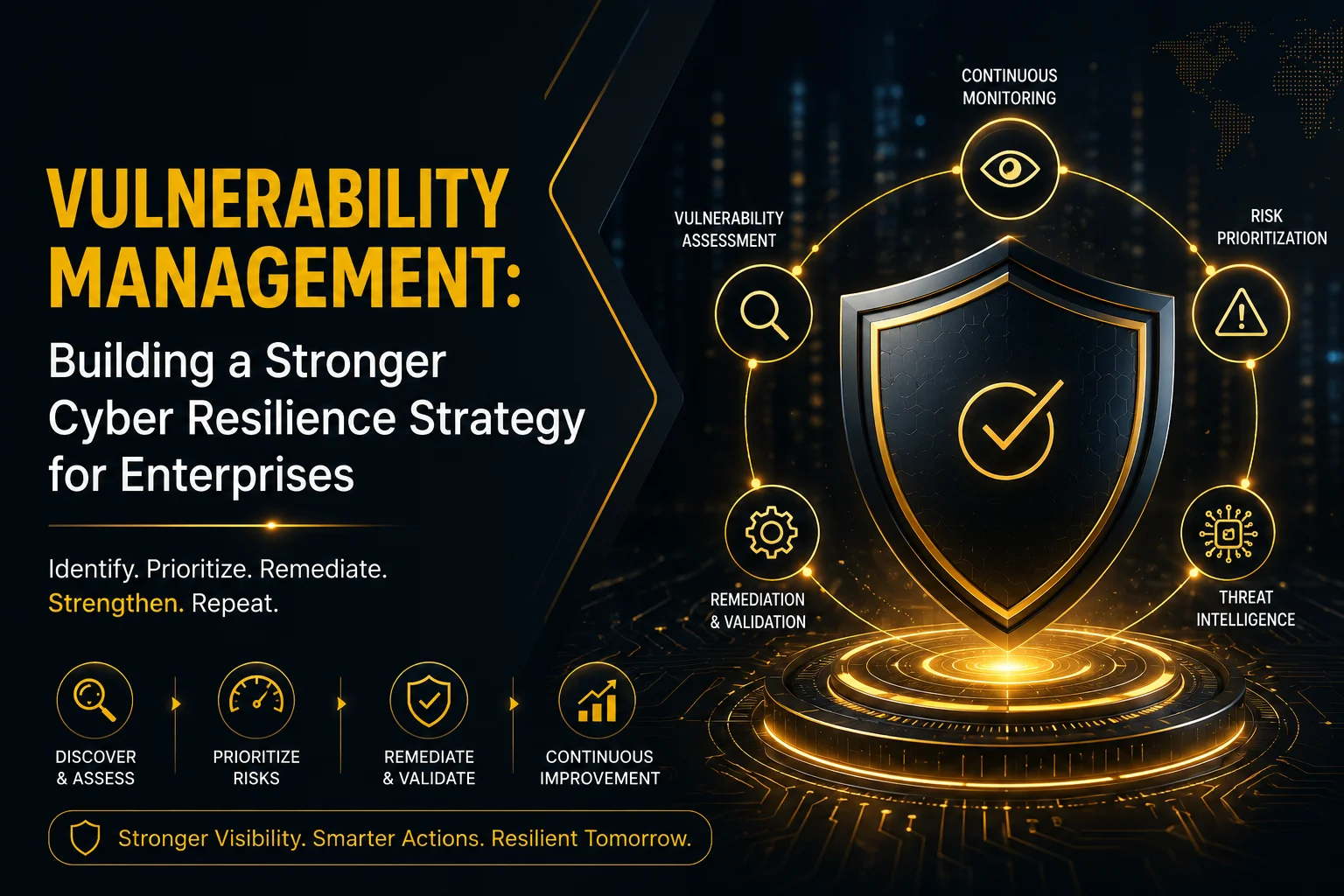
An effective Vulnerability Management program follows a structured lifecycle that begins with asset discovery. Organizations must first identify every connected device, server, cloud workload, application, and digital asset within their environment. Unknown assets often become the easiest targets for attackers.
Once assets are identified, automated vulnerability scanning is performed to detect known security weaknesses. These findings are then analyzed using risk-based prioritization, which considers factors such as vulnerability severity, business impact, threat intelligence, exploit availability, and asset criticality.
Security teams then implement remediation through software updates, security patches, configuration changes, or compensating controls. Finally, verification ensures that vulnerabilities have been successfully resolved while continuous monitoring detects any newly emerging risks. This lifecycle enables organizations to maintain a continuously improving security posture rather than relying on periodic assessments.
AI-Powered Vulnerability Management
Artificial Intelligence is transforming the way organizations manage cyber risks. Traditional vulnerability management often generates thousands of findings, making it difficult for security teams to determine which issues require immediate attention. AI-powered Vulnerability Management addresses this challenge by automatically analyzing vulnerability data, correlating threat intelligence, identifying active exploits, reducing false positives, and prioritizing remediation based on real-world business risk.
This intelligent approach enables security teams to respond faster, improve operational efficiency, and reduce the likelihood of successful cyberattacks. AI also helps organizations gain deeper visibility into emerging threats, allowing them to strengthen cyber resilience without increasing operational complexity.
At AmbiSure Technologies, AI-driven insights enhance decision-making by enabling organizations to focus their resources where they will have the greatest impact on enterprise security.
Benefits of Continuous Vulnerability Management
Organizations that implement continuous Vulnerability Management experience significant improvements in their overall cybersecurity maturity. They gain complete visibility into their IT environment, reduce their attack surface, improve compliance with security standards, and strengthen their ability to respond to emerging threats.
Continuous monitoring also supports better patch management by helping IT teams prioritize updates based on actual business risk instead of simply applying patches indiscriminately. Executive leadership benefits from centralized dashboards and real-time reporting, providing greater visibility into organizational cyber risk and enabling informed strategic decisions.
Perhaps most importantly, continuous Vulnerability Management reduces the likelihood of costly cyber incidents by identifying and addressing exploitable weaknesses before attackers can take advantage of them.
Why Choose AmbiSure Technologies?
At AmbiSure Technologies, we understand that every organization has unique security challenges. Our Vulnerability Management Services are designed to provide continuous visibility, intelligent risk prioritization, and actionable remediation guidance tailored to your business environment.
Our cybersecurity experts combine advanced scanning technologies, AI-driven analytics, industry best practices, and compliance expertise to help organizations across India and the Middle East proactively manage cyber risks. Whether your business operates in banking, healthcare, manufacturing, retail, government, logistics, or critical infrastructure, we deliver customized solutions that strengthen your cyber resilience while supporting your long-term business objectives.
Conclusion
Cyber threats continue to evolve at an unprecedented pace, and organizations can no longer rely on reactive security strategies. Vulnerability Management provides a proactive and continuous approach to identifying, prioritizing, and remediating security weaknesses before they become business-critical incidents.
By adopting AI-powered Vulnerability Management, organizations can reduce cyber risk, strengthen compliance, improve operational resilience, and protect their digital assets against increasingly sophisticated threats. As enterprises across India and the Middle East continue to expand their digital operations, investing in continuous Vulnerability Management is no longer optional—it is essential for building a secure and resilient future.
Secure Your Business with AmbiSure Technologies
Don’t wait for attackers to discover your vulnerabilities before you do. Partner with AmbiSure Technologies to implement AI-driven Vulnerability Management that provides continuous monitoring, intelligent risk prioritization, and enterprise-grade cyber resilience.
Contact our cybersecurity experts today to schedule a Cyber Risk Assessment and discover how AmbiSure can help your organization stay secure, compliant, and prepared for tomorrow’s evolving threat landscape.
Threat Intelligence • SOC Services • VAPT • Cloud Security • Endpoint Protection • Compliance •Incident Response
