
Table of Contents
- What Is a Social Media Threat?
- How Social Media Threats Happen
- What Does a Social Media Threat Look Like?
- Ways to Prevent Social Media Threats
- Why Social Media Security Matters for Modern Enterprises
- How AmbiSure Technologies Protects Your Digital Brand
- Frequently Asked Questions
- Final Thoughts
What Is a Social Media Threat?
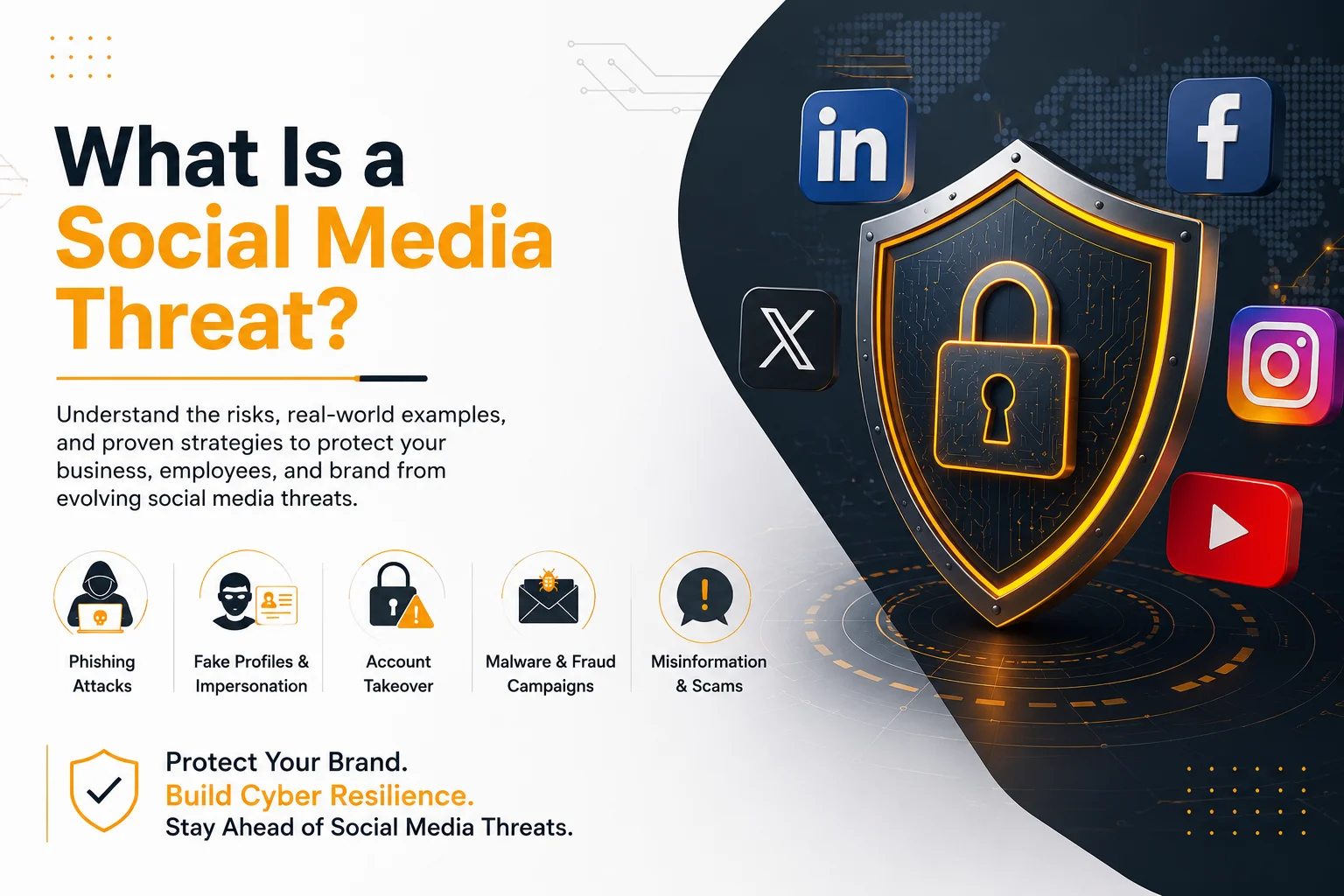
Social media has transformed the way organizations communicate with customers, partners, employees, and stakeholders. Platforms such as LinkedIn, Facebook, Instagram, X (formerly Twitter), YouTube, and TikTok have become essential business channels for brand awareness, recruitment, customer engagement, and digital marketing. However, the same platforms that enable organizations to reach millions of people also provide cybercriminals with new opportunities to launch sophisticated attacks. As businesses expand their digital footprint, social media has evolved into one of the fastest-growing attack surfaces in modern cybersecurity.
A social media threat is any malicious activity conducted through social networking platforms with the intention of compromising an individual, employee, organization, or brand. These threats include phishing campaigns, fake business profiles, account takeovers, executive impersonation, malware distribution, identity theft, misinformation campaigns, financial fraud, credential theft, and AI-powered social engineering attacks. Unlike traditional cyberattacks that primarily target servers or endpoints, social media threats exploit human trust and online interactions, making them significantly more difficult to detect before damage occurs.
For enterprises operating in highly regulated industries such as banking, healthcare, manufacturing, retail, government, education, and technology, social media threats are no longer a marketing concern—they are a critical cybersecurity challenge. A single compromised corporate account or successful impersonation campaign can expose confidential business information, disrupt operations, damage customer trust, and result in substantial financial and reputational losses.
Today’s cybercriminals leverage artificial intelligence, automated bots, deepfake technology, and publicly available information from employee profiles to create convincing attacks that appear completely legitimate. As a result, organizations must treat social media security as an integral part of their cyber resilience strategy, combining proactive monitoring, threat intelligence, identity protection, and incident response to reduce digital risk.
Why Social Media Has Become a Major Cybersecurity Risk
The rapid adoption of digital communication has dramatically increased the amount of sensitive information shared online. Employees frequently publish job titles, project updates, conference participation, organizational achievements, and professional relationships on social media platforms. While these activities support networking and brand visibility, they also provide cybercriminals with valuable intelligence that can be weaponized against an organization.
Threat actors carefully analyze publicly available information to understand company structures, identify decision-makers, map supplier relationships, and learn about internal technologies. This intelligence enables attackers to craft highly personalized phishing campaigns, business email compromise (BEC) attacks, fake recruitment offers, and executive impersonation scams that are far more convincing than generic cyberattacks.
The rise of AI-generated content has further increased the sophistication of these threats. Deepfake videos, cloned voices, and automated phishing messages make it increasingly difficult for employees and customers to distinguish legitimate communications from malicious ones. Organizations that fail to implement continuous social media monitoring and digital risk protection are significantly more vulnerable to fraud, credential theft, and brand abuse.
How Social Media Threats Happen
Social media threats rarely begin with advanced hacking techniques. Instead, they often start with information gathering and psychological manipulation. Cybercriminals spend weeks or even months studying an organization’s online presence, employee activity, executive communications, customer interactions, and digital marketing campaigns before launching an attack.
One of the most common attack methods involves creating fake social media profiles that closely resemble legitimate corporate accounts. Attackers copy company logos, branding elements, employee photographs, and business descriptions to create convincing impersonation pages. These fraudulent accounts are then used to communicate with customers, distribute malicious links, advertise fake promotions, or collect sensitive financial information.
Executive impersonation has become another rapidly growing threat. Cybercriminals clone the identities of CEOs, directors, HR managers, or senior executives and send connection requests or direct messages to employees and business partners. Once trust has been established, victims may be instructed to review confidential documents, authorize financial transactions, purchase gift cards, share login credentials, or download malware disguised as business files.
Social engineering campaigns also exploit trending news, industry events, product launches, recruitment campaigns, and viral discussions. By aligning malicious messages with topics that employees are already discussing, attackers significantly increase the likelihood that users will click on fraudulent links or disclose confidential information.
Modern cybercriminals increasingly combine multiple attack techniques—including phishing, credential harvesting, malware distribution, ransomware deployment, and account takeover—to maximize their chances of success. A single compromised employee account can quickly provide attackers with access to internal communications, customer databases, cloud applications, and business-critical systems.
Because social media operates outside traditional network security controls, many organizations struggle to identify these threats until substantial damage has already occurred. This is why proactive monitoring, threat intelligence, employee awareness training, and rapid incident response have become essential components of enterprise social media security.
Business Impact of Social Media Threats
For many organizations, the consequences of a successful social media attack extend far beyond the loss of a single account. A compromised social media presence can disrupt customer trust, expose sensitive corporate information, damage investor confidence, violate regulatory requirements, and create lasting reputational harm. Attackers frequently use hijacked accounts to spread misinformation, launch cryptocurrency scams, distribute malware, or impersonate the organization during customer interactions.
Financial losses are also increasing. Organizations may face fraudulent payment requests, legal liabilities, regulatory penalties, recovery costs, incident response expenses, and revenue loss caused by damaged brand credibility. In highly competitive industries, reputational damage alone can impact customer retention and future business opportunities long after the technical incident has been resolved.
As digital transformation accelerates, protecting social media channels is no longer optional. It is a fundamental requirement for maintaining business continuity, customer confidence, and overall cyber resilience.
What Does a Social Media Threat Look Like?
Modern social media threats are rarely obvious. Unlike the cyberattacks of the past, today’s attackers focus on deception rather than technical complexity. They carefully imitate trusted brands, executives, employees, and business partners to manipulate people into revealing sensitive information or performing actions that compromise organizational security. Because these attacks exploit human trust instead of software vulnerabilities, they often bypass traditional security tools such as firewalls and antivirus solutions.
A typical social media attack may begin with something as simple as a LinkedIn connection request, a Facebook message, an Instagram direct message, or a comment on a corporate post. At first glance, the interaction appears genuine. The profile contains professional photographs, realistic employment history, mutual connections, and recent activity. Once trust has been established, the attacker gradually persuades the victim to download a malicious document, share confidential information, approve a payment, or click on a phishing link. By the time the victim realizes something is wrong, sensitive data may already be compromised.
As organizations continue to expand their digital presence, cybercriminals are increasingly targeting businesses through social media because these platforms provide direct access to employees, executives, customers, and partners without needing to breach traditional network defenses.
Fake Business Profiles and Brand Impersonation
One of the most common and damaging forms of a social media threat is brand impersonation. Cybercriminals create fake social media pages that closely resemble official company accounts by copying logos, cover images, branding, product descriptions, and even customer reviews. These fraudulent accounts often have usernames that differ by only one character, making them difficult for users to identify.
Customers who unknowingly interact with these fake accounts may be encouraged to participate in fraudulent giveaways, claim fake discounts, verify their accounts, or make payments through unofficial channels. Attackers frequently request sensitive information such as login credentials, banking details, or one-time passwords while pretending to represent legitimate customer support teams.
Beyond financial fraud, fake business profiles significantly damage customer trust. Even if an organization quickly removes the fraudulent account, customers who experience scams associated with the company’s brand may hesitate to engage with the business in the future. This reputational damage often extends beyond the immediate incident, affecting customer loyalty and long-term business growth.
Organizations that implement continuous Brand Protection, Digital Risk Protection, and Threat Intelligence solutions can identify impersonation attempts much earlier, reducing both financial and reputational risk.
Executive Impersonation and Business Email Compromise
Senior executives have become primary targets for cybercriminals because they possess authority, visibility, and influence within an organization. Attackers frequently clone executive profiles on LinkedIn and other professional networking platforms to establish credibility before launching highly targeted social engineering campaigns.
After creating a convincing fake profile, attackers connect with employees, suppliers, or business partners and begin normal conversations that gradually build trust. Eventually, victims receive requests that appear urgent and legitimate, such as approving confidential documents, reviewing contracts, authorizing financial transfers, purchasing gift cards, or updating corporate payment details.
These attacks often support larger Business Email Compromise (BEC) campaigns, where information collected through social media is later used in email fraud. Because the communication appears to come from a trusted executive, employees may bypass standard verification procedures, resulting in significant financial losses.
Modern AI technologies have made these attacks even more convincing. Deepfake voice calls and AI-generated video messages now enable attackers to convincingly imitate executives during live conversations, making verification increasingly difficult for organizations that lack strong identity validation processes.
Social Media Phishing Attacks
Phishing remains one of the most successful cyberattack techniques, and social media has become a preferred delivery channel. Instead of sending mass emails, attackers now distribute malicious links through direct messages, sponsored advertisements, comments, and fake recruitment offers.
A typical phishing campaign may invite users to verify their corporate accounts, apply for attractive job opportunities, access confidential business reports, or participate in industry surveys. The links redirect victims to realistic-looking login pages designed to capture usernames, passwords, and multi-factor authentication codes.
Because these messages are often personalized using publicly available information gathered from employee profiles, they appear significantly more trustworthy than traditional phishing emails. The combination of personalization and urgency dramatically increases the likelihood of successful credential theft.
For organizations using cloud-based collaboration platforms, stolen credentials can provide attackers with access to email systems, document repositories, CRM platforms, financial applications, and sensitive customer information.
Account Takeover Attacks
Corporate social media accounts represent valuable digital assets. They often have thousands—or even millions—of followers who trust the organization’s communications. This makes them attractive targets for cybercriminals seeking financial gain or reputational damage.
Account takeover attacks typically occur after credentials are stolen through phishing campaigns, password reuse, weak authentication, or malware infections. Once attackers gain administrative access, they may immediately change passwords, remove legitimate administrators, disable security settings, and begin publishing fraudulent content.
Compromised accounts are frequently used to promote cryptocurrency scams, fake investment opportunities, malicious software downloads, counterfeit products, or misinformation campaigns. In many cases, customers are unable to distinguish fraudulent posts from legitimate company announcements because they originate from verified corporate accounts.
Recovering a compromised social media account can take days or even weeks, during which organizations may experience lost customer confidence, negative media attention, and declining brand credibility.
Implementing Multi-Factor Authentication (MFA), privileged access management, continuous account monitoring, and rapid incident response significantly reduces the likelihood of successful account takeover attacks.
Malware Distribution Through Social Media
Social media platforms have become effective channels for distributing malicious software. Cybercriminals disguise malware as business presentations, invoices, HR documents, software updates, promotional materials, or industry reports. Victims often download infected files believing they originate from trusted colleagues or legitimate organizations.
Once installed, malware may steal credentials, encrypt business files, monitor user activity, capture keystrokes, or establish persistent access to corporate networks. Advanced malware can remain undetected for extended periods while attackers quietly collect sensitive business information before launching ransomware or data exfiltration campaigns.
Because malware often enters organizations through trusted employee interactions, endpoint security alone is insufficient. Businesses require integrated threat intelligence, endpoint detection and response (EDR), Security Operations Center (SOC) monitoring, and proactive incident response capabilities to rapidly identify malicious activity.
AI-Powered Social Engineering and Deepfake Threats
Artificial Intelligence has dramatically changed the cybersecurity landscape. Attackers now use generative AI to create convincing phishing messages, realistic business emails, cloned executive voices, and high-quality deepfake videos capable of deceiving employees, investors, and customers.
Imagine receiving a video message from your CEO requesting an urgent financial transfer or hearing a familiar executive voice asking you to approve confidential documents. Without proper verification procedures, these AI-generated communications can easily bypass traditional human judgment.
Deepfake technology is becoming increasingly accessible, allowing cybercriminals to produce highly realistic content with minimal technical expertise. As AI continues to evolve, organizations must strengthen identity verification, employee awareness training, and digital authentication processes to defend against increasingly sophisticated deception techniques.
Why Traditional Security Is No Longer Enough
Many organizations continue to rely primarily on firewalls, antivirus software, and email security gateways. While these technologies remain essential, they were never designed to detect fake social media profiles, executive impersonation, brand abuse, or AI-generated social engineering attacks.
Effective protection against social media threats requires continuous visibility across the public digital landscape. Organizations need solutions capable of identifying fake accounts, monitoring brand mentions, detecting credential exposure, tracking leaked corporate information, identifying malicious domains, and responding rapidly to emerging threats.
This is where Threat Intelligence, Brand Protection, Digital Risk Protection, Attack Surface Management (ASM), and 24×7 Security Operations Center (SOC) services become critical. These capabilities provide real-time insight into evolving threats, enabling security teams to detect and mitigate risks before they impact business operations.
Key Takeaway
Social media has become one of the most attractive attack surfaces for cybercriminals because it combines public visibility, human trust, and direct access to employees and customers. Whether through fake profiles, phishing campaigns, executive impersonation, account takeovers, malware distribution, or AI-powered deepfakes, modern attackers are constantly developing new ways to exploit organizations.
Businesses that proactively monitor their digital presence, implement strong identity controls, educate employees, and invest in enterprise-grade cybersecurity solutions are significantly better positioned to defend against these evolving threats while protecting their reputation, customers, and long-term business resilience.
Ways to Prevent Social Media Threats
Preventing social media threats requires much more than setting strong passwords or limiting who can access corporate accounts. As cybercriminals become more sophisticated, organizations need a proactive cybersecurity strategy that combines technology, governance, employee awareness, and continuous monitoring. The goal is not simply to respond to attacks after they occur, but to identify risks early, reduce the organization’s digital exposure, and build long-term cyber resilience.
Businesses that integrate social media security into their overall cybersecurity framework are significantly better prepared to defend against phishing campaigns, brand impersonation, account takeovers, insider threats, and AI-powered social engineering attacks.
Implement Strong Identity and Access Management
The first step in reducing social media risk is controlling who has access to official business accounts. Many organizations continue to share passwords among marketing teams, agencies, and third-party vendors, creating unnecessary security risks. Every individual who manages corporate social media should have a unique account with role-based permissions that provide only the access necessary for their responsibilities.
Multi-Factor Authentication (MFA) should be mandatory across all social media platforms. Even if login credentials are compromised through phishing or malware, MFA creates an additional layer of protection that significantly reduces the likelihood of unauthorized access.
Organizations should also review user permissions regularly, immediately revoke access for departing employees, and maintain a clear approval process for granting administrative privileges. These identity management practices reduce the attack surface while improving overall account security.
Monitor Your Brand Continuously
One of the biggest mistakes organizations make is assuming that attackers will target only their official social media accounts. In reality, cybercriminals often create fake pages, duplicate executive profiles, fraudulent advertisements, and impersonation websites that operate unnoticed for weeks or even months.
Continuous Brand Protection and Digital Risk Protection services enable organizations to detect fake social media profiles, counterfeit domains, phishing websites, leaked credentials, and unauthorized use of corporate branding before these threats cause widespread damage.
By monitoring digital channels in real time, businesses can identify suspicious activity early, request fraudulent content removal, alert customers, and reduce the impact of impersonation attacks.
Continuous monitoring also protects brand reputation by ensuring that customers always interact with legitimate company channels instead of malicious copies designed to steal personal or financial information.
Educate Employees Against Social Engineering
Technology alone cannot stop social media threats. Human awareness remains one of the most effective security controls because most social media attacks rely on deception rather than technical exploitation.
Employees should receive regular cybersecurity awareness training focused specifically on recognizing phishing attempts, executive impersonation, suspicious connection requests, malicious links, fake recruitment messages, and AI-generated content.
Training should include realistic simulations that mirror current attack techniques. When employees learn to identify warning signs in a controlled environment, they become significantly more resistant to real-world attacks.
Organizations should also establish clear reporting procedures so employees know exactly how to respond if they encounter suspicious messages or believe their accounts may have been compromised. A culture of early reporting enables security teams to investigate incidents before they escalate.
Secure Corporate Social Media Accounts
Every official social media account represents a valuable business asset that should be managed with the same level of protection as critical business systems.
Organizations should maintain an inventory of all official accounts, ensure recovery information remains current, enable login alerts, and review authentication settings on a regular basis. Passwords should be unique, complex, and stored securely using enterprise password management solutions instead of shared spreadsheets or messaging applications.
Administrative access should be restricted to authorized personnel, while external agencies should receive temporary permissions whenever possible rather than permanent administrative control.
Routine security reviews help organizations identify inactive accounts, outdated permissions, and configuration weaknesses that could otherwise become entry points for attackers.
Leverage Threat Intelligence for Proactive Defense
Modern cyber threats evolve rapidly, making reactive security insufficient for enterprise environments. Organizations require real-time visibility into emerging attack techniques, leaked credentials, malicious infrastructure, and threat actor activity.
A comprehensive Threat Intelligence Platform continuously collects and analyzes global cyber threat data to identify indicators of compromise relevant to an organization’s industry, geography, and digital assets.
Threat intelligence enables businesses to understand who is targeting them, which attack methods are being used, and what proactive actions should be taken before an incident occurs.
When integrated with Security Operations Center (SOC) monitoring, threat intelligence significantly improves detection capabilities while reducing response times during active security incidents.
Adopt a Zero Trust Security Strategy
Traditional security models assumed that users inside the corporate network could generally be trusted. Modern cybersecurity has shifted toward a Zero Trust approach, where every user, device, and access request must be continuously verified regardless of location.
Applying Zero Trust principles to social media security means verifying every login, restricting privileged access, monitoring user behavior, and continuously evaluating risk before granting access to sensitive resources.
This approach reduces the impact of stolen credentials because attackers cannot automatically move through systems even after compromising a legitimate account.
Zero Trust also supports secure remote work environments where employees access corporate social media accounts from multiple devices and geographic locations.
Build a Rapid Incident Response Capability
Even organizations with mature cybersecurity programs cannot eliminate every threat. The difference between a minor security event and a major business crisis often depends on how quickly the organization responds.
An effective Incident Response Plan should clearly define responsibilities, communication procedures, investigation workflows, evidence preservation processes, and recovery activities related to compromised social media accounts.
When an account takeover or impersonation incident occurs, organizations should immediately isolate affected accounts, revoke unauthorized access, notify customers if necessary, preserve forensic evidence, and begin recovery procedures.
Rapid response minimizes operational disruption while reducing reputational and financial damage.
Organizations that conduct regular incident response exercises are significantly better prepared to manage real-world cyber incidents under pressure.
Monitor the External Attack Surface
Social media is only one component of an organization’s digital presence. Attackers frequently combine information collected from social platforms with exposed cloud assets, forgotten websites, leaked credentials, and vulnerable internet-facing systems.
Attack Surface Management (ASM) continuously discovers and monitors all externally accessible digital assets, helping organizations identify vulnerabilities before cybercriminals exploit them.
When combined with Brand Protection and Threat Intelligence, ASM provides complete visibility across the organization’s digital ecosystem, allowing security teams to prioritize remediation based on actual business risk.
Continuous attack surface monitoring also supports regulatory compliance and strengthens enterprise cyber resilience.
Integrate AI-Powered Security Monitoring
Artificial Intelligence has become essential for modern cybersecurity operations. AI-powered monitoring solutions analyze millions of events across social media platforms, cloud environments, endpoints, and networks to identify suspicious behavior that traditional security tools may overlook.
Machine learning enables organizations to detect abnormal login patterns, credential abuse, impersonation campaigns, bot activity, and coordinated attacks much earlier than manual investigation alone.
While attackers increasingly use AI to automate phishing and deception campaigns, defensive AI provides security teams with faster detection, improved threat correlation, and more efficient incident response.
Organizations that combine human expertise with AI-driven security operations are better equipped to respond to today’s rapidly evolving cyber threat landscape.
How AmbiSure Technologies Helps Protect Your Business
At AmbiSure Technologies, we understand that social media security extends far beyond protecting individual accounts. It is about safeguarding your organization’s reputation, customer trust, intellectual property, and digital identity.
Our enterprise cybersecurity services help organizations proactively detect, investigate, and respond to social media threats before they disrupt business operations.
Our comprehensive cybersecurity capabilities include:
- Brand Protection and Digital Risk Protection
- Threat Intelligence Services
- Security Operations Center (SOC) Monitoring
- Incident Response and Digital Forensics
- Attack Surface Management (ASM)
- Vulnerability Assessment and Penetration Testing (VAPT)
- Identity and Access Security
- Security Awareness Training
- Cyber Resilience Consulting
- AI-Driven Threat Detection and Monitoring
Whether your organization operates across India, the Middle East, or global markets, AmbiSure delivers the expertise, technology, and strategic guidance needed to strengthen your cybersecurity posture and protect your digital brand against evolving social media threats.
Building Long-Term Cyber Resilience
Protecting against social media threats is not a one-time project—it is an ongoing process that requires continuous monitoring, regular security assessments, employee awareness, and adaptive defense strategies.
Organizations that invest in proactive cybersecurity measures are better positioned to detect emerging threats, protect customer trust, comply with regulatory requirements, and maintain business continuity in an increasingly connected digital world.
As social media continues to evolve, businesses must remain equally agile by integrating security into every aspect of their digital strategy. A proactive approach today can prevent costly cyber incidents tomorrow.
Ready to Secure Your Digital Presence?
Every day, cybercriminals target businesses through fake social media accounts, phishing campaigns, executive impersonation, and AI-powered scams. Don’t wait for an incident to expose vulnerabilities in your organization.
Partner with AmbiSure Technologies to strengthen your social media security with enterprise-grade Brand Protection, Threat Intelligence, Security Operations Center (SOC) services, Attack Surface Management, Incident Response, and Cyber Resilience solutions.
Contact AmbiSure Technologies today for a Social Media Threat Assessment and discover how proactive cybersecurity can protect your brand, your customers, and your business from evolving digital threats.
