
A cyberattack rarely happens at a convenient time.
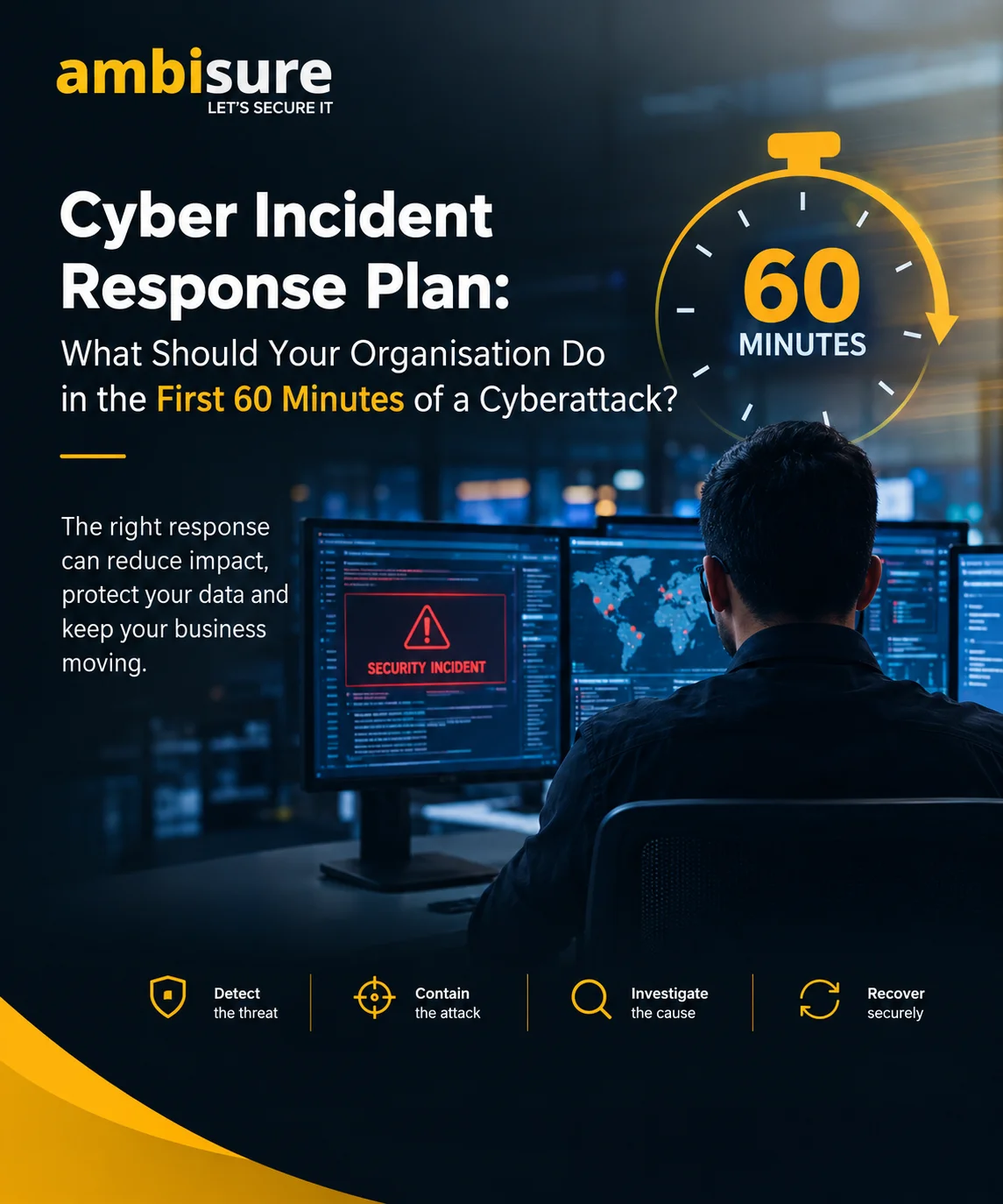
It may begin with something that appears insignificant — a suspicious login, an employee clicking on a phishing email, an unusual process running on an endpoint, or an alert from your security monitoring system.
At first, your team may not know how serious the situation is.
Then the questions begin. Has someone actually compromised the network? Which systems are affected? Has sensitive data been accessed? Is the attacker still inside the environment? Should a system be isolated? Who needs to be informed?
This is where the first 60 minutes can make a significant difference.
A strong cybersex incident response plan gives your organization a clear way to assess the situation, contain the threat, preserve evidence and make informed decisions while the incident is still developing.
Why the First 60 Minutes Matter
When an attacker gains access to an organization, time can work against the business. The longer an attacker remains undetected, the greater the opportunity to move across systems, compromise additional accounts, access sensitive information or disrupt critical operations.
However, responding quickly does not mean acting without a plan.
For example, immediately shutting down a compromised system may appear to be the safest option, but doing so could remove valuable evidence needed to understand how the attacker entered the environment and what they did after gaining access.
The objective during the first hour should therefore be controlled response rather than rushed response.
Start by Understanding What Happened
The first step in a cybersex incident is establishing whether the activity represents a genuine security incident.
A suspicious login, malware alert or unusual network connection may have a legitimate explanation. At the same time, dismissing unusual activity too quickly can allow a real attacker to continue operating inside the environment.
The security team needs to establish what has happened, which systems or accounts may be affected and whether the threat is still active.
At this stage, having access to reliable security monitoring and an experienced incident response team can significantly improve the quality and speed of the initial assessment.
Activate the Right Incident Response Team
A serious cybersex incident should not be treated as an IT problem alone.
Depending on the severity of the incident, the response may involve the CISO, SOC, IT and infrastructure teams, legal and compliance, communications, business leadership and senior management.
Everyone should understand their responsibilities before an incident occurs.
If an organization is trying to determine who has authority to make decisions while an attacker is actively moving through the environment, valuable time can be lost.
An effective incident response plan should clearly define escalation procedures, decision-making responsibilities and communication channels.
Contain the Threat Without Destroying Evidence
Once an incident has been confirmed, the immediate priority is to prevent the threat from spreading further.
This could involve isolating a compromised endpoint, disabling a compromised account, restricting network access or blocking malicious communication.
However, containment needs to be carefully managed.
An organization needs to stop the attacker while also preserving the information required to investigate the incident. This is particularly important when the incident involves ransomware, data theft, insider activity or a potentially significant security breach.
This is one of the areas where professional incident response services can provide valuable support. Experienced responders can help organization make containment decisions while maintaining the integrity of the investigation.
Preserve Digital Evidence
During a cyberattack, the natural reaction is often to start cleaning affected systems immediately.
That can be a mistake.
Before systems are wiped, rebuilt or significantly modified, organization should consider what evidence may be required to understand the incident.
System logs, endpoint information, network activity and other digital evidence can help investigators determine how the attacker gained access, when the compromise began, which systems were accessed and whether sensitive information was exposed.
This is where digital forensics becomes an important part of cybersex security incident response.
Preserving evidence properly can also become important when an organization needs to deal with legal, regulatory, insurance or law-enforcement requirements.
Understand the Full Scope of the Incident
Finding one compromised computer does not necessarily mean that the incident is limited to that machine.
The compromised endpoint could be the visible part of a much larger attack.
The response team needs to understand whether other endpoints, user accounts, servers, cloud environments or privileged credentials have also been affected.
This is where understanding the attacker’s movement becomes critical.
The organization needs to determine not only where the incident started, but also how far the attacker may have travelled through the environment.
Understanding this blast radius helps security and business leaders make better decisions about containment, recovery and communication.
Keep the Business Running Where Possible
Cybersecurity teams naturally focus on the technical aspects of an incident. Business leaders, however, need to consider another question:
What happens to the organization if these systems remain unavailable?
For a financial institution, an incident could affect transactions and customer services. For a manufacturer, it could interrupt production. For a healthcare organization, it could affect critical operations. For an IT services company, it could impact customer environments.
This is why incident response should be closely connected to business continuity and cybersex resilience.
The objective is not simply to remove the attacker. The organization also needs to understand how to maintain or restore critical business operations safely.
Communication Matters During a Cyber Crisis
A major cybersex incident can create confusion very quickly.
Employees may hear that systems are unavailable. Customers may begin asking questions. Senior management may require updates. Legal and compliance teams may need information to assess reporting obligations.
Without a clear communication structure, different teams can end up working with different versions of the situation.
An effective incident response plan should establish who is responsible for internal communication, who communicates with customers or partners when necessary, and who handles regulatory or external communication.
Clear communication helps prevent a security incident from becoming a wider business crisis.
Find the Root Cause
Containing an attack is not the same as understanding it.
Once the immediate threat has been controlled, the organization needs to determine how the attacker gained access in the first place.
It could have been a stolen credential, a phishing attack, an unpatched vulnerability, a misconfigured cloud environment, an exposed service or a compromised third party.
Finding the root cause is essential because fixing only the visible symptoms can leave the original weakness in place.
If the entry point remains open, the organization may eventually face another incident through the same weakness.
Recovery Should Be Controlled
Once the threat has been contained and the affected environment has been properly investigated, recovery can begin.
This may involve restoring clean backups, rebuilding compromised systems, resetting credentials, applying security patches and increasing monitoring across critical environments.
But recovery should not simply mean bringing everything back online as quickly as possible.
The organization needs reasonable confidence that the threat has been removed and that the systems being restored are secure.
The goal is not just to recover. The goal is to recover safely.
Learn From the Incident
Once systems are restored and operations return to normal, it can be tempting to consider the incident finished.
This is where organization can miss one of the most valuable opportunities to improve their security.
A proper post-incident review should examine what happened, how quickly the organization detected it, how effective the containment process was, whether escalation worked as expected and where the response could have been better.
The findings should then be used to improve security controls, policies, processes and the organization’s overall cybersex resilience strategy.
Why Incident Response Plans Need to Be Tested
Having an incident response document is not the same as being prepared for a cyberattack.
The real test comes when people have to make decisions under pressure.
This is why cybersecurity tabletop exercises are valuable. They allow organization to simulate realistic scenarios such as ransomware, data breaches, compromised credentials or cloud security incidents without waiting for a real attack.
A tabletop exercise can reveal gaps that may not be obvious when a plan is simply reviewed on paper.
It can show whether the security team knows what to do, whether leadership understands its role and whether different departments can work together when the organization is under pressure.
Your Incident Response Plan Should Work Before the Incident Happens
The biggest mistake an organization can make is waiting for a real cyberattack to discover that its response process does not work.
Security technologies are important, but technology alone cannot decide who should be called, when a system should be isolated, how evidence should be preserved or when senior leadership should be involved.
Those decisions need to be considered before the crisis.
A mature cybersex incident response plan brings people, processes and technology together so that the organization can respond with greater clarity when an incident occurs.
How AmbiSure Technologies Can Help
At AmbiSure Technologies, we help organization strengthen their ability to prepare for, respond to and recover from cybersecurity incidents.
Our capabilities include Incident Response, Digital Forensics, Ransomware Readiness, Vulnerability Assessment and Penetration Testing, Security Posture Assessment and Cyber Resilience.
The objective is not simply to respond after something goes wrong. It is to help organization understand their exposure, prepare their teams and develop a response capability that can operate effectively when it matters most.
The First 60 Minutes Should Not Be Improvised
You cannot always predict when a cyberattack will happen.
You can, however, prepare your organization for what happens when one does.
The first 60 minutes are about establishing facts, making informed decisions, containing the threat and protecting the business while the investigation continues.
The question every CISO and business leader should be asking is not “Will we ever face a cybersex incident?” but “Are we prepared to respond when we do?”
Is your organization ready for the first 60 minutes?
Talk to AmbiSure Technologies about strengthening your Incident Response and Cyber Resilience readiness.
📞 +91 98204 02468
📧 security@ambisure.com
🌐 www.ambisure.com